
How Sylvester.ai Decodes What LLMs Can’t
Frances Valentine PhD (Lead Animal Behaviorist) & Mike Berg (CTO) for Sylvester.ai
One of the ways cats communicate is through subtle facial expressions and while LLMs excel in understanding and generating language, they are not fundamentally designed to detect feline-specific, nuanced signals such as pain. Ngai et al. 2025 evaluated LLM agreement to expert pain scoring. The authors concluded that most chatbots showed poor agreement with experts and this could lead to over-or underestimating feline pain. In fact a recent study by Martvel et al. 2025 found that the performance of LLMs in dog emotion recognition relied heavily on contextual features such as background and breed and urged for species-sensitive approaches based on validated behaviours.
Sylvester.ai has a unique advantage to outpace large vision-language models (LVLMs) in the field of cat behavior analysis. Our vision models are purpose-built to detect the subtle signals of pain in cats. Sylvester.ai’s technology learns from direct observation of real cats through advanced computer vision models trained on professionally labelled datasets of cats with a variety of health conditions.
Behind this innovation lies Sylvester.ai’s large, curated medicalized datasets. Images are annotated with behavioural cues by feline experts, creating a foundation of truth that continues to improve with scale and diversity. These datasets enable Sylvester.ai to produce actionable insights for caregivers and veterinarians, transforming the way feline health is monitored.
Our research demonstrates the specialized interpretive capabilities of the Sylvester model compared to general Large Language Models (LLMs). When presented with identical images of a cat—one in a gloomy setting and one in a sunny setting—a general LLM's assessment of the cat's pain or discomfort was inconsistent and influenced by the background. In contrast, the Sylvester model consistently identified the cat as being in discomfort in both images, highlighting its enhanced ability to interpret subtle facial cues regardless of environmental factors. This interpretation was independently validated: a trained behaviourist confirmed the cat was experiencing pain, which was later diagnosed as severe dental disease requiring caudal mouth extractions.
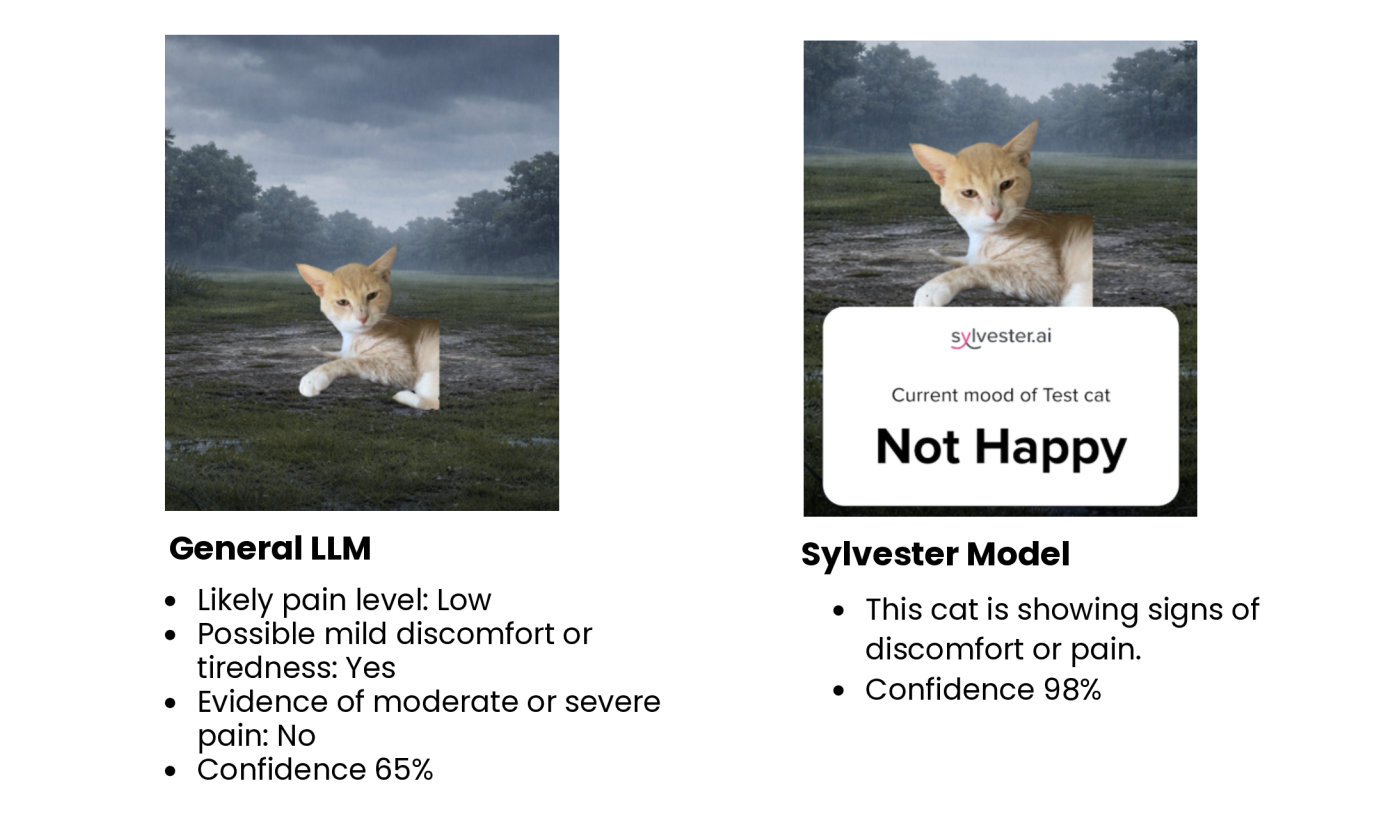
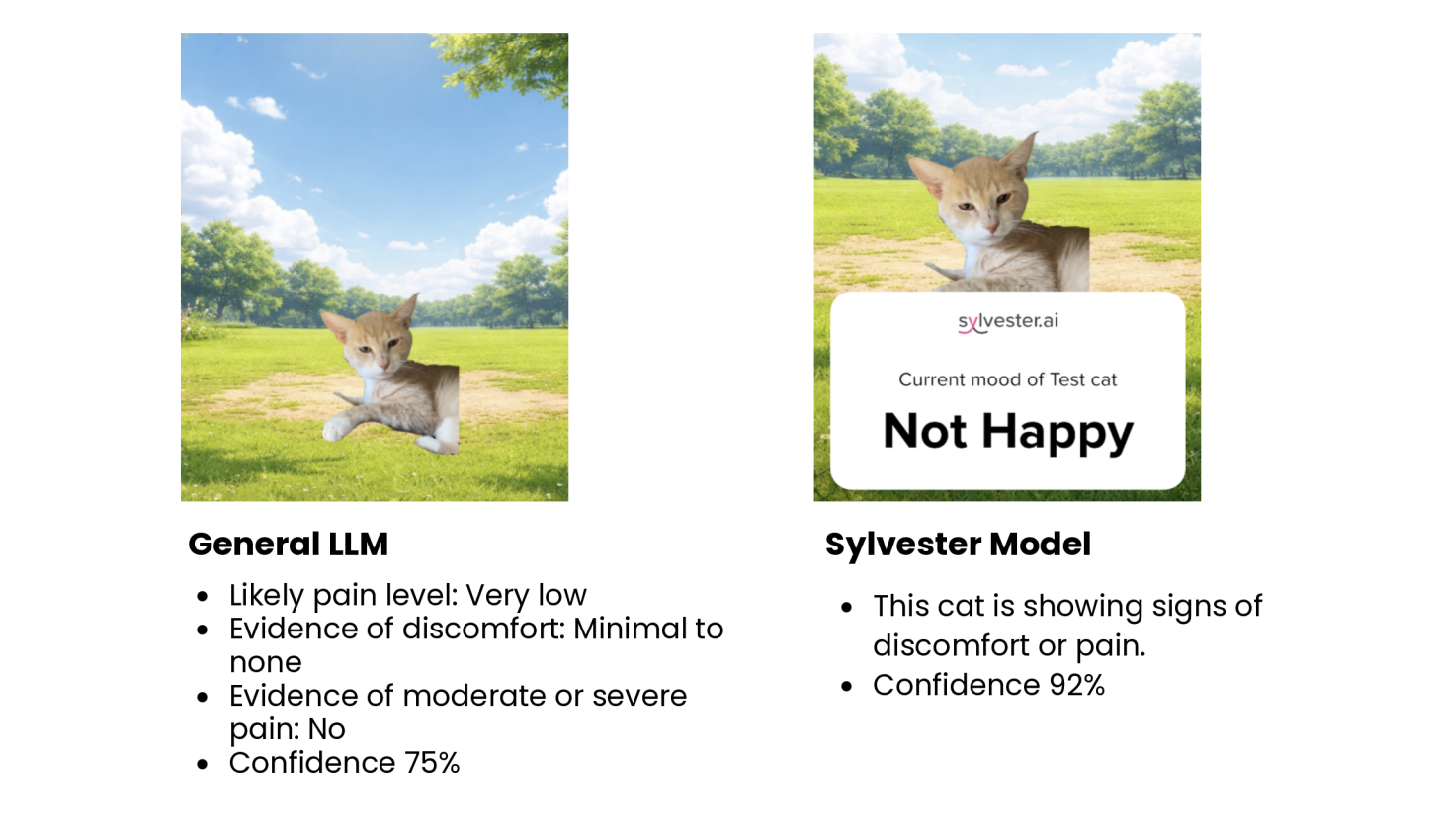
An image of a cat with severe dental disease was presented to a general LLM and the Sylvester.ai model with two different contextual backgrounds (gloomy and sunny). While the general LLM was influenced by the cat’s background in its assessment, the Sylvester model identified the cat’s discomfort regardless of background, highlighting its ability to interpret subtle facial cues.
As computer vision becomes ubiquitous across camera-based devices, Sylvester.ai’s technology will seamlessly integrate into connected pet platforms and veterinary workflows, empowering real-time health monitoring and deep behavioral understanding. In short, where LLMs can only describe animal behavior abstractly, Sylvester.ai can see and understand it—redefining the frontier of AI for animal care.
Martvel et al. 2025. Investigating the capabilities of large vision language models in dog emotion recognition. Sci. Rep. 15: 41250. https://doi.org/10.1038/s41598-025-25199-7
Ngai et al. 2025. Agreement of Feline Grimace Scale scores between chatbots and an expert rater. Sci. Rep. 15: 43461. https://doi.org/10.1038/s41598-025-27404-z